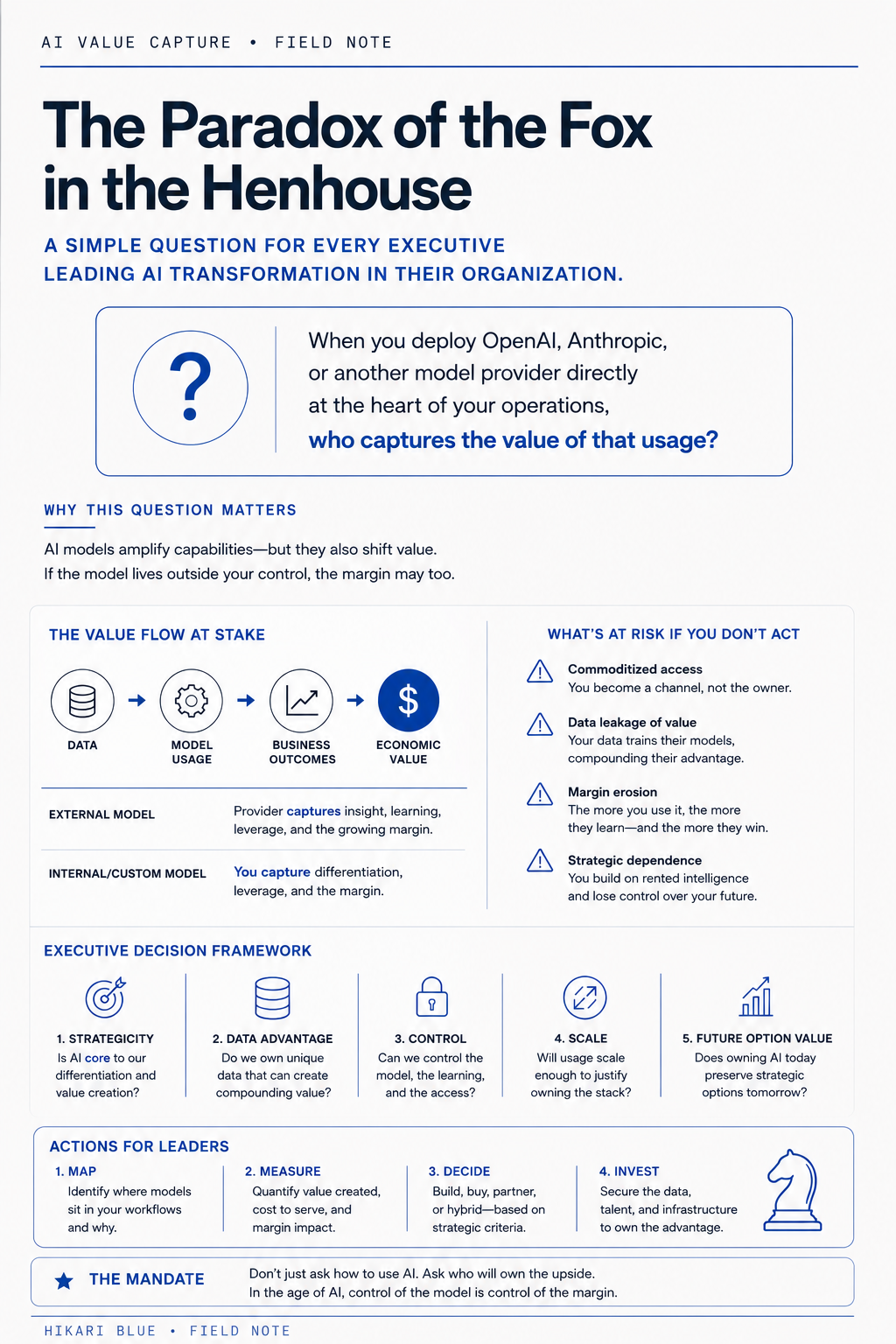
The answer is worth a pause. Your queries feed the continuous training and improvement of their models. Your use cases inform their product roadmaps. Your volumes fund their next generations.
And in parallel, those same providers are launching or funding vertical applications that compete head-on with your own business lines.
This is not a failure on their part. It is the normal mechanics of a player maximizing its position. It is a failure on the part of whoever lets that mechanism run without a counterweight.
The layer that separates usage from the provider
The real question is not whether to pick Anthropic, OpenAI, Mistral, or Gemini. The real question is: who arbitrates token allocation across these providers, on what criteria, and with what level of traceability?
An organization that owns this arbitration layer keeps three decisive levers.
First, it can route every use case to the most performant and cost-effective model at any given moment, without locking contractual dependencies. The foundation model market is commoditizing at accelerating speed. Performance gaps between equivalent models are now measured in weeks, not years. Without an arbitration layer, you keep paying yesterday's leader's price.
Second, it retains ownership of its usage data, its business prompts, its agentic workflows. These assets are not peripheral. They are the codified expression of your operational know-how. Handing them over in plain text to a third-party provider amounts to outsourcing your competitive edge to the actor best positioned to replicate it.
Third, it can document end to end what is requested, from which model, with which data, for which outcome. On the road to full EU AI Act enforcement, this traceability shifts from convenience to regulatory obligation. Organizations in regulated sectors operating without such a governance layer will find themselves non-compliant by construction.
The shift in value
The thesis deserves to be stated plainly.
Value in enterprise AI no longer concentrates on the models themselves. It is migrating to the integration, alignment, and governance layer that separates business usage from raw capacity providers. Hikari Blue · operator note
It is this layer that allows a bank, an insurer, an industrial operator, or a pharmaceutical company to:
- Keep control of its technical choices without being subject to its providers' strategic pivots.
- Orchestrate AI agents within an auditable and compliant framework.
- Build a capital of proprietary prompts, workflows, and knowledge that appreciates over time instead of dissolving into third-party models.
The organizations that accept disruption are the ones standing still. Worse: the ones actively accelerating their own disruption by integrating, without counterweight, the very players whose mission is to replace them.
A governance question, not a technology one
This is not an architect's debate. It is a board decision.
He who controls the tokens controls the spice. And he who controls the spice controls the table.
At Hikari Blue, we work with executive committees at financial institutions, insurers, and regulated industrial groups to build this control layer before the EU AI Act makes it mandatory.
The question to bring to the next board
Don't just ask how to use AI.
Ask who will own the upside.
In the age of AI, control of the model is control of the margin.
The Hikari Blue team · Austin, May 2026