Hikari Blue · Operator notes Austin · Strasbourg · Osaka No. 36 · Edition of October 6, 2026
The Newsroom · Hikari Blue
Field briefings for AI operators.
Operating notes on AI governance, agentic systems, enterprise architecture, regulation and execution risk. Written from the field. Published when defensible.
Latest briefings
Latest field briefings
-
Latest briefing Field briefing HB-2026-0036 Enterprise AI architecture · Enterprise software · United States
Microsoft 365 Copilot Business bills agents by usage on December 1. The default Copilot Credits cap exceeds the license price.
From December 1, 2026, new Microsoft 365 Copilot Business licenses sold through CSP default to pay-as-you-go Copilot Credits, capped at 4,000 credits per user per month. At Microsoft's $0.01 rate that is $40, against a $21 list seat. We price the cap, read the defaults behind it and name what a CFO and a CIO decide before December 1.
Read briefing -
Field briefing HB-2026-0035 AI strategy · Logistics and transportation · United States
C.H. Robinson prices RXO on Lean AI. Its own filings show headcount fell faster than cost.
C.H. Robinson agreed on October 5, 2026 to buy RXO for $5.8 billion, priced on $300 million of Lean AI synergies. Its own filings show headcount fell far faster than cash cost. We recompute what the price asks of RXO and name the metric to track.
Read briefing -
Field briefing HB-2026-0034 Agentic systems · Retail and commerce · United States
Amazon blocked Meta's Muse with its Conditions of Use. The Ninth Circuit pointed it there.
Amazon began blocking Meta's Muse agent on September 20, 2026, citing its Conditions of Use. We read the Agent Terms, the August 4 Ninth Circuit ruling in Amazon v. Perplexity, and the decision every enterprise with a customer login now faces.
Read briefing -
Field briefing HB-2026-0033 Agentic systems · HR and payroll · United States
Paychex counts 2,000 AI agents. Its 10-Q attributes no savings to them.
Paychex reported more than 2,000 AI agents and features on September 23, 2026. Its 10-Q attributes no savings to them. We rebuild the 1% expense growth line by line and name the metric a board should track.
Read briefing -
Field briefing HB-2026-0032 AI strategy · Enterprise software · United States
Salesforce projects 3x to 4x ARR from wall-to-wall Agentforce customers. Build your AI case on that bill.
Salesforce's September 16, 2026 investor day projects 3x to 4x ARR from Agentforce customers. We turn that into a support-labor break-even and a contract.
Read briefing -
Field briefing HB-2026-0031 AI strategy · Healthcare · United States
Astrana Health credits AI with a 210 bps G&A gain. Earn-out accounting explains 76 bps.
Astrana Health's September 15, 2026 deck credits AI with a 210 bps G&A gain. We rebuild it from the 10-Q: earn-outs, Prospect, full-risk revenue.
Read briefing -
Field briefing HB-2026-0030 AI execution risk · United States
Oracle's $664 billion backlog is a third-party risk input for banks on OCI.
Oracle reported $664 billion of RPO on September 10, 2026. We read its filings against bank third-party risk guidance: backlog timing, prepayments, leases.
Read briefing -
Field briefing HB-2026-0029 AI execution risk · United States
Accenture is staffing Gemini Enterprise with 1,000 forward deployed engineers. It employs 799,000.
On September 8, 2026 Accenture and Google Cloud announced the Accenture Gemini Enterprise Business Group, which will establish a 1,000-person forward deployed engineer workforce built on Accenture's existing 50,000 Google Cloud-skilled professionals. That is 2 percent of the practice and 0.13 percent of the firm. Accenture stopped publishing its advanced AI bookings and revenue after the quarter reported on December 18, 2025, so no vendor series exists against which to check whether the embedded engineering model converts into delivered work.
Read briefing -
Field briefing HB-2026-0028 Enterprise architecture · United States
Anthropic is moving Claude data retention into your cloud account. The misuse flags come with it.
On June 9, 2026 Anthropic made 30-day retention mandatory for Covered Models and unavailable under zero data retention. On September 1 it announced Enterprise Frontier Safeguards, which moves that window into the customer's own cloud account under the customer's keys and audit log. The platform documentation carries a second sentence, in a section called Retention regardless of arrangement: even under ZDR or a HIPAA arrangement, a flagged session can be retained for up to 2 years. The announcement does not say whether that exception survives the move.
Read briefing -
Field briefing HB-2026-0027 AI strategy · United States
Nvidia booked $96 billion. Most US AI adopters stop at three business functions.
Nvidia's 10-Q for the quarter ended July 26, 2026 discloses one direct customer at 16 percent of revenue and five direct customers holding 70 percent of accounts receivable. The US Census Bureau, measuring November 2025 to January 2026, found 18 percent of US firms using AI in a business function, and 57 percent of those adopters running it in three functions or fewer. The variable their regression associates with commercial performance is breadth, which is the variable most adopters have not moved.
Read briefing -
Field briefing HB-2026-0026 Execution risk · Market data licensing
Cboe redefined non-display usage to cover LLMs. Your research agent reads at a different price.
On April 1, 2026 Cboe amended the definition of Non-Display Usage in its North American Data Policies so that machine access counts unless it is solely in support of display for a natural person. The filing says plainly that the change targets firms leveraging Large Language Models. Four months later Google Cloud shipped a research agent for capital markets with connectors to LSEG, S&P Global and FactSet. Entitlement controls answer who may see the data. They do not answer what a machine may do with it.
Read briefing -
Field briefing HB-2026-0025 Agentic systems · Platform strategy
Claudeforce puts Salesforce behind Claude. What remains is the permission model.
On August 26, 2026 Salesforce and Anthropic announced Claudeforce. The first product, Salesforce in Claude, ships 37 prebuilt sales skills that read live revenue context and take governed action from inside Claude, in pilot now with an open beta expected in September. The announcement moves the value of the CRM from the interface to the permission model, and that reading applies to every company that lets agents act, not only to Salesforce customers.
Read briefing -
Field briefing HB-2026-0024 Enterprise architecture · Agent attestation
The Linux Foundation now governs TRACE. Your agent audit log is not evidence.
On August 25, 2026 the Linux Foundation welcomed TRACE, an open specification for hardware-attested AI agent governance records contributed by OPAQUE and backed by AMD, Intel, Microsoft and TII. The specification is at v0.2. Its own limitations file states that the software-only tier does not satisfy EU AI Act tamper-evident logging or DORA.
Read briefing -
Field briefing HB-2026-0023 AI strategy · United States
OpenAI cut GPT-5.6 prices 80 percent. The frontier tier did not move.
In late July 2026 OpenAI cut GPT-5.6 Luna by 80 percent, Terra by 20 percent, and left the flagship Sol at $5 and $30 per million tokens. The gap between the cheapest and the most expensive tier widened from 5x to 25x. Canva and Wix both published what that costs.
Read briefing -
Field briefing HB-2026-0022 Agentic systems · United States
Synchrony put promotional financing inside ChatGPT. Regulation Z came with it.
On August 17, 2026 Synchrony put promotional financing offers inside ChatGPT. Promotional financing is 35.3 percent of a $103.8 billion book, deferred interest alone 17.7 percent. Regulation Z attaches to the advertisement, and its exemptions name envelopes and banner ads, not generated answers.
Read briefing -
Field briefing HB-2026-0021 Regulation · United States
The US does not have an AI Act. It has regulators.
No federal statute governs enterprise AI in the United States. A voluntary NIST framework, a Colorado law rewritten twice, five sector regulators, an FTC accuracy policy, and the EU AI Act's extraterritorial reach all apply to the same enterprise at once, on seven different clocks.
Read briefing -
Field briefing HB-2026-0020 AI strategy · Energy and infrastructure
Google signed one gigawatt of demand response. AI is cut first.
Google has signed one gigawatt of data center demand response and made machine learning workloads the first thing it cuts. On August 17 the six US grid operators file the rules that turn conditional service into a tariff category. Which of your AI workloads may pause is becoming a procurement question.
Read briefing -
Field briefing HB-2026-0019 Enterprise architecture · Clinical development
The regulator now reads the trial while it runs.
Two sponsors already send endpoints and safety signals to the FDA while their studies run. Selection for the broader pilot closes this month. The prize is cycle time. The constraint is whether your evidence is stable enough to be read while it is still moving.
Read briefing -
Field briefing HB-2026-0018 Agentic systems · Browser automation
The cheapest integration is now a logged-in browser tab.
From August 3, an agent drives desktop Chrome signed in as your employee. It automates the portals integration never paid for. It also acts under a person's identity.
Read briefing -
Field briefing HB-2026-0017 Execution risk · Agent runtimes
AWS deprecated Bedrock Agents without a deadline.
AWS moved Bedrock Agents to maintenance mode on July 30 and froze its model catalog. Existing agents keep running. That is precisely why nobody escalates.
Read briefing -
Field briefing HB-2026-0016 Strategy · Insurance claims
The carriers bought the workflow, not the model.
A top-five insurer scaled AI subrogation in the second quarter. The vendor discloses its gain. The carrier discloses nothing and answers the examiner alone.
Read briefing -
Field briefing HB-2026-0015 Regulation · EU AI Act
The audit trail is the product.
Brussels moved the calendar on the EU AI Act. It did not touch what Articles 12, 19 and 26 require a governed AI system to record.
Read briefing -
Field briefing HB-2026-0014 Architecture · Agent-facing surface
The channel that converts best cannot read your site.
More than half of all web requests are now automated. AI-referred shoppers convert better than every other channel, and up to 46 percent of retailer sites cannot be read by machines. The public surface became an interface, and nobody on the org chart owns it.
Read briefing -
Field briefing HB-2026-0013 Architecture · AI control plane
When every employee has an agent, routing is the decision.
Cisco is giving 90,000 employees an AI agent that routes to the cheapest sufficient model, on premise. The decision was never the model. It is the layer that routes, prices, and records every model you run.
Read briefing -
Field briefing HB-2026-0012 Strategy · Operating leverage
The banks quantified their AI gains. The margin will not follow.
In Q2 2026 earnings, US banks proved AI saves real hours. Jamie Dimon told the market why that does not become margin. The operator question boards should ask.
Read briefing -
Field briefing HB-2026-0011 Strategy · Capital allocation
AI value is moving from the model to the operating layer.
Two AI leaders spun up implementation businesses in one quarter. The value is not in the model. It is in the layer that turns a model into governed production work.
Read briefing -
Operator essay HB-2026-0010 Strategy · European AI sovereignty
Can Europe still win the AI war?
The continent that invented modern science risks becoming the regulator of technologies built elsewhere. A signed essay on power, dependence and the narrowing window.
Read briefing -
Field briefing HB-2026-0009 Regulation · EU cybersecurity
Your model is now a cyber capability.
The EU Action Plan on Cybersecurity and AI moves the model itself inside the security perimeter. What it asks of operators in finance, energy and health.
Read briefing -
Field briefing HB-2026-0008 Regulation · EU AI Act
The deadline moved. The exposure did not.
The EU AI Act high-risk deadline slid from August 2026 to December 2027. What still bites in August, and why the risk never moved with the date.
Read briefing -
Field briefing HB-2026-0007 Regulation · EU AI Act
What actually lands on August 2.
The Digital Omnibus moved the high-risk deadline to December 2027. The enforcement machine goes live on schedule. The board question that follows.
Read briefing -
Field briefing HB-2026-0006 Execution risk · Agentic systems
The agent no one owns.
Ask each agent in production who owns it and who can stop it. In most enterprises, no one can answer. The inventory is the first control.
Read briefing -
Field briefing HB-2026-0005 Governance · Agentic systems
Govern the action, not the model.
Model choice is commoditized. The risk lives at the execution layer, where agents call tools and take action. NIST is standardizing exactly that, and your board will ask for the trace.
Read briefing -
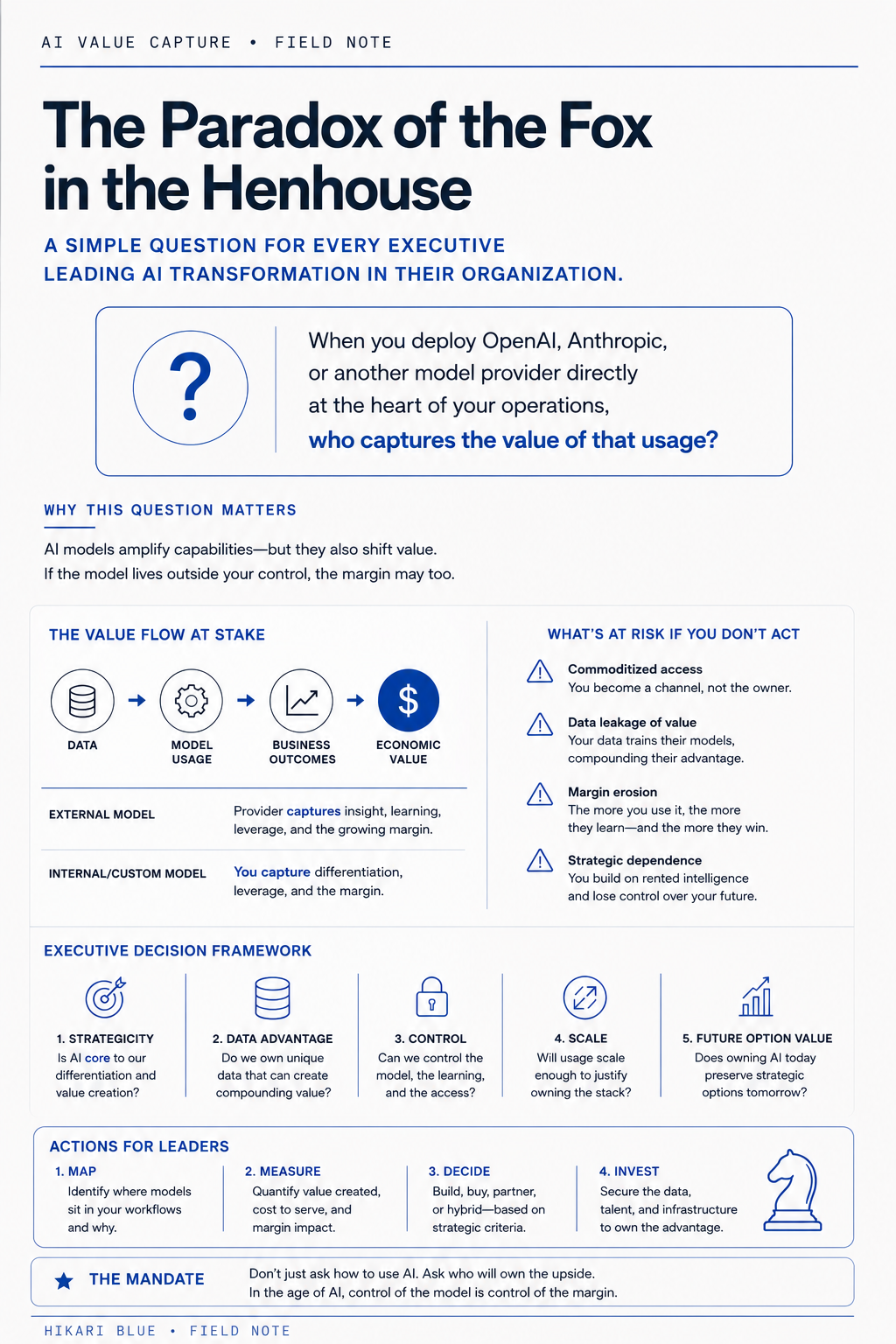
Field briefing HB-2026-0001 Strategy · AI value capture
The fox in the henhouse paradox.
When you deploy OpenAI, Anthropic, or any other model provider at the core of your operations, who captures the value of that usage? The board-level question that decides whether AI builds you a margin or absorbs it.
Read briefing -
Field briefing HB-2026-0003 Strategy · Executive courage
Silence on AI is a decision.
Why strategic silence is becoming a governance failure for executive teams, and the three conversations no board can afford to keep postponing.
Read briefing -
Field briefing HB-2026-0004 Strategy · Operator culture
AI does not replace thinkers. It amplifies builders.
From Brynjolfsson to Musk, the converging frame on AI: a test of sovereignty, not a technology question.
Read briefing -
White paper HB-2026-0002 Governance · Architecture
AI governance is an architecture problem. White paper, in French.
Twenty pages on why generative AI projects fail, and what the few that succeed build first. WP-HB-2026-00426 · FR.
Open the white paper
Research themes
Six lenses we publish through.
Click to filter
The long-form pillars behind the lenses: AI governance · Agentic AI · AI strategy · Artificial intelligence · What is an AI operating layer?
About the Newsroom
The HIKARI BLUE newsroom is where we publish our field briefings on AI governance, agentic systems, enterprise architecture, regulation, and execution risk.
These are not trend pieces. They are field briefings for leaders who need to understand what AI changes, what it exposes, and what must be built before autonomy can be trusted.
Published by HIKARI BLUE's operating team. Written from the field, not from the feed.
Stay in the field
Receive the next field briefing.
Hikari Blue field briefings go to executives, founders, CIOs and board members across Europe and North America. No fixed cadence: posted when defensible. Signal only.
Read by leaders across financial services · luxury · healthcare · energy
Press inquiries: reach the team directly · answered by a named partner, not an agency