Two of the best capitalized names in artificial intelligence just told the market where the money is. It is not in the model.
In a single quarter, Anthropic and OpenAI each launched a company whose only job is to install their models inside other businesses. Anthropic's venture, Ode, opened with 1.5 billion dollars behind it and backers including Blackstone and Goldman Sachs (TechCrunch, 2026). OpenAI built a parallel arm it calls The Deployment Company. The prevailing story of the last three years put value in the model. Whoever trained the strongest system would take the market. These two moves read the opposite way.
Why two model makers are selling the install, not the model
The reason is on the record. One engineer building the Anthropic venture put it plainly: model selection matters, but it is not where the majority of calories are spent (TechCrunch, 2026). The model is now an input. The work, and the margin, is the installation around it.
The evidence for that is not in a demo. It is on an insurer's operating metrics. AIG runs a multi-agent underwriting system built with Anthropic and Palantir. On its Q1 2026 earnings call, the company reported that the system lifted quoted submissions by 30 percent, cut time to quote for underwriters by 55 percent, and raised the share of submissions bound by roughly 40 percent (AIG Q1 2026 earnings call, May 1, 2026). The same call noted that individual agents now run autonomously for as long as 30 hours, against less than one hour a year earlier.
Read those numbers carefully. They are not model benchmarks. They are workflow outcomes. The gain came from wiring a model into underwriting through an orchestration layer, not from access to a smarter model.
One honest caveat. AIG's headline results that quarter were strong, with the General Insurance combined ratio at 87.3 percent and underwriting income near 774 million dollars (AIG, Form 8-K, Q1 2026). The company attributed those results to underwriting discipline, lower catastrophe losses, and favorable reserve development, not to AI. The AI contribution shows up one level down, in the throughput of the workflow. That is precisely the point. Value from AI is captured at the operating layer, where it is measured in cycle time and capacity, not on the model line.
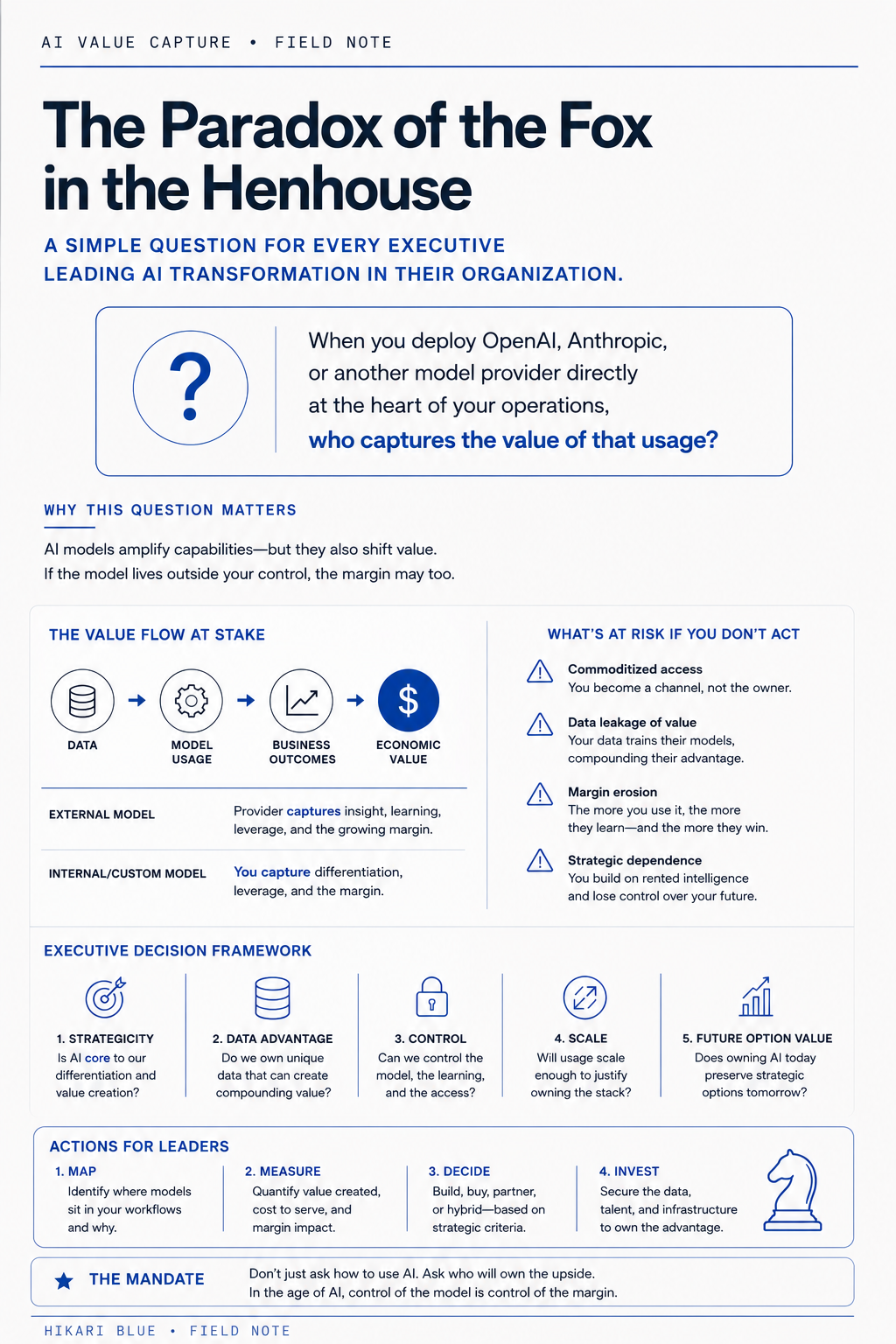
Value in enterprise AI is not captured at the model. It is captured at the operating layer that turns a model into governed, auditable production work. Hikari Blue · operator note
What this changes for the people allocating capital
The failure data points the same direction. MIT's NANDA study found that 95 percent of enterprise generative AI pilots delivered no measurable profit and loss impact (MIT NANDA, 2025). Those are not model failures. The models work. The failures sit in the layer around them: integration, data, ownership, and governance. Buying more model access does not close that gap. Building the layer does.
For a board, this reframes the budget line. AI is not a licence you buy by the seat. It is an operating system you build once and run: model routing, data plumbing, agent orchestration, and an audit trail that survives a regulator's question. The AIG result came from that kind of build inside one workflow, not from a wider rollout of a chatbot. In a regulated sector, the layer is also what makes the system defensible. It is where you can show what an agent did, on which data, under which control.
This is where the two new ventures cut both ways. The providers now selling you the model also sell you the install. Renting the last mile is convenient and it is not the same as owning the operating layer. If a third party owns the layer between the model and your regulated profit and loss, that third party owns your throughput, your workflow knowledge, and, in effect, your audit trail. The players best placed to replicate your edge are the ones you would be handing it to.
The question to bring to the next board
Do not open with which model to buy. That decision is close to commoditized and it will change again next quarter.
Ask who owns the layer between the model and your regulated profit and loss. Then ask whether that owner is you.
The model is rented. The operating layer is where the margin is kept.
- TechCrunch (2026). Anthropic, Blackstone bet the next trillion-dollar AI business is implementation, not just models. Reports Anthropic's Ode venture at 1.5 billion dollars with backers including Blackstone and Goldman Sachs, OpenAI's parallel arm The Deployment Company, and the "not where the majority of calories are spent" quote. techcrunch.com/2026/07/15
- American International Group (2026). Q1 2026 earnings call, CEO Peter Zaffino, 1 May 2026. Reported figures for the AIG multi-agent underwriting system built with Anthropic and Palantir: quoted submissions up 30%, time to quote down 55%, submissions bound up roughly 40%, agents running autonomously up to 30 hours. reinsurancene.ws
- American International Group (2026). Form 8-K, First Quarter 2026 Earnings Release. General Insurance combined ratio 87.3% and underwriting income of 774 million dollars, attributed to underwriting, lower catastrophe losses, and favorable reserve development. sec.gov (AIG 8-K, Q1 2026)
- MIT Project NANDA (2025). The State of Enterprise Generative AI: the GenAI Divide. Finding that 95% of enterprise generative AI pilots delivered no measurable profit and loss impact. nanda.media.mit.edu
Reference documents
The Hikari Blue team · Austin, July 2026