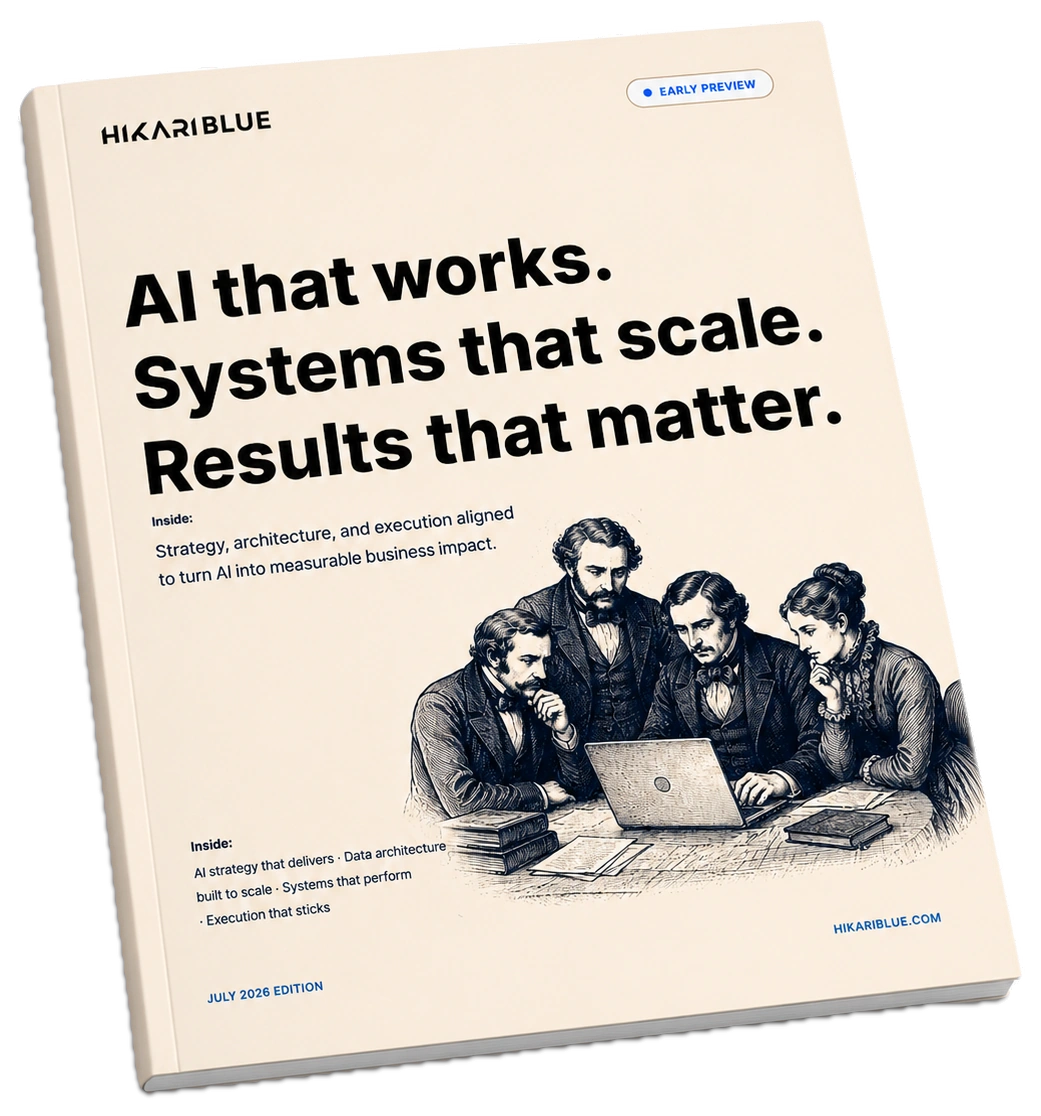
The AI Operating Playbook · 2026 edition
Could your AI estate survive a board review tomorrow?
12 questions expose the gap between a working pilot and a governable production system. Ten seconds each. Hesitation counts as no.
- 32 pages
- A 25-minute read
- 4 operating instruments
- English and French editions
Start here
Three of the twelve. Answer from memory.
If you cannot answer from memory, the control does not yet belong to the system. The remaining nine questions are below.
The diagnosis
A pilot proves capability. Production proves control.
Different objects, different evidence, and no gain in model quality converts one into the other. Four structural failure modes explain why AI programs stall after the pilot, not during it.
01 · Evidence debt
The board reads a green pilot dashboard. Humans assembled that evidence for the review. The tell: nobody exports ninety days of decisions unaided.
02 · Threshold drift
Legal signs off, then reopens the file weeks before launch. Production scope crossed into a higher risk tier. The tell: nobody states the classification without checking.
03 · Model monoculture
A provider outage becomes a board topic. Prompts, evaluations and controls are wired to one vendor. The tell: engineering prices a swap in quarters.
04 · Orphan runtime
Usage decays quietly six months after launch. Run was funded as the leftover line. The tell: the last kill-switch test carries no date.
Inside the playbook
Four instruments you can use at your next executive committee.
Real excerpts, not mockups. Attribution is not required.
01The board-readiness diagnostic
Twelve closed questions, scored in three bands. An executive answers each in under ten seconds, without calling anyone.
"Can you name, today, the person accountable for each AI workflow running in production?"Question 01 of 12 · page 11
02The decision-rights map
Eight decisions that determine production entry, each with one named owner. Committees advise; they do not own.
"Kill-switch authority: halt, throttle, roll back · CEO, standing authority held 24/7 by a named on-call operator."Row 6 of 8 · page 14
03The first ninety days
Two workflows in production with an audit trail a regulator can read. A plan, not a maturity model.
"Days 0 to 30: census and classification. Output: a register of every workflow already in production, risk-tiered and owned."Step 1 of 6 · page 19
04Twelve questions for any AI vendor
Copy them verbatim into an RFP. A strong vendor answers each in one line, in writing, before signature.
"Name the second model provider we can move to, and state in hours the time to shift production traffic."Question 01 of 12 · page 25
The diagnostic
Twelve questions. Answer yes or no, from memory.
Your answers stay in your browser. Hesitation counts as no.
0 of 12 answered
The exchange
The playbook, against a professional identity.
No phone number. No hidden sequence. Your diagnostic result travels with your request so the conversation, if you want one, starts from your gaps rather than from a pitch.
Delivered
The playbook is yours.
Your personal download link is below, valid for seventy-two hours. If it does not appear, write to contact.
Written for
The people a board will actually question.
- CEO and COOWhich decisions run without a human, and what loss the firm accepts when the model is wrong.
- CIO, CTO and CDOWhose keys encrypt which data, in which jurisdiction, and what halts a failing model in minutes.
- Risk, Compliance, Legal, Internal AuditWhether the evidence is contemporaneous, or a reconstruction assembled for the review.
- ProcurementTwelve questions a weak AI vendor cannot answer in one line, sent before the demo.
Written by the operators who run these systems in regulated production. References: Regulation (EU) 2024/1689, DORA, NIS2, NIST AI RMF 1.0, ISO/IEC 42001:2023. Priority sectors: financial services, healthcare and medtech, luxury, sensitive infrastructure. Orientation, not legal advice.
Questions
Before you ask.
What does it cost?
Nothing. The playbook is exchanged for a professional identity: name, work email, organization, role. No phone number, no hidden sales sequence.
Who is it written for?
CEOs, CIOs, CTOs and the risk, compliance and audit functions of regulated enterprises. If you run AI pilots and a board questions you about them, it is written for you.
What is the format?
A 32-page A4 PDF, in English or in French, built around four operating instruments and a doctrine of the operating layer. A 25-minute read.
What happens to my data?
Delivery only, unless you separately opt in to receive Hikari Blue analyses. The opt-in box is never pre-checked. Your diagnostic answers stay in your browser and are attached to your request only when you submit the form.
How often is it updated?
The 2026 edition is revised as the doctrine and the regulatory base move. Requesters of a given edition are not re-contacted about new ones unless they opted in.